Tuesday, October 1, 2024

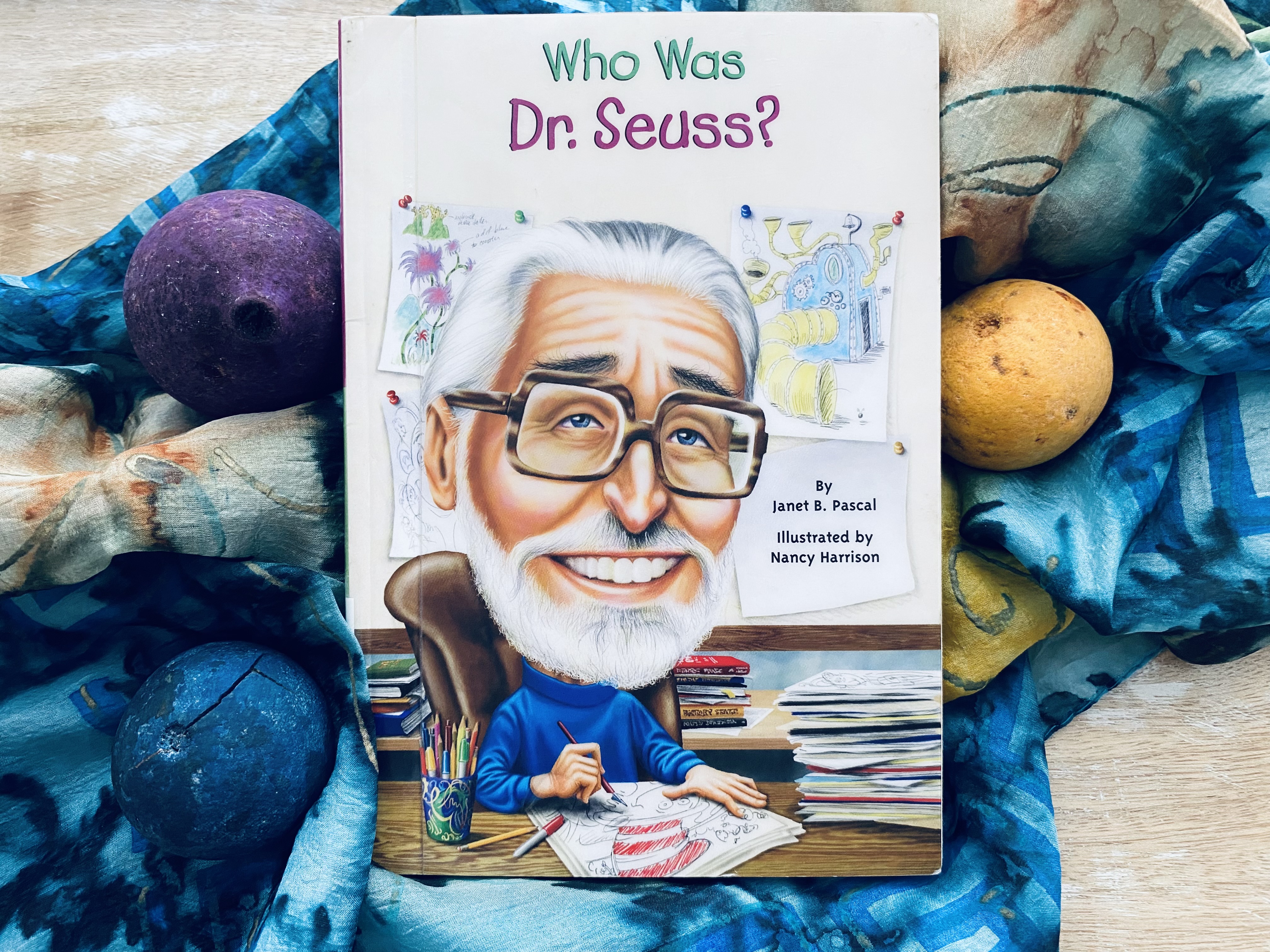
Who Was Dr. Seuss? by Janet Pascal


 Who Was ...? biography series for middle grade brings captivating figure of Dr. Seuss who became an illustrator and author and changed children’s books forever. 

Theodor Seuss Geisel was born on March 2, 1904, in Springfield, Massachusetts. He loved to hang around the zoo. He was also known for exaggerating when telling stories. He liked writing jokes for the school paper. At Dartmouth College, he became editor-in-chief as the students loved his stories and drawings. 

After college, he got a job as an illustrator. And later, started writing for Judge magazine. He introduced his strange and playful creatures. He signed the column, “Dr. Seuss.” Doctor because he didn’t get the doctorate degree and disappointed his father.

He became very successful as an illustrator. It led him to illustrating children’s books. And later to also write and illustrate stories. The Cat in the Hat was published in 1957, and became one of his most popular stories. 

With time, in his writings, he touched on subjects of environment and on not taking action when wars broke out in Europe. There was some opposition to it, but he stood up for what he believed in. He was writing for humanity. He received a Pulitzer Prize, which was never given to a children’s book writer before.

In 1990, he published his last book, Oh the Places You’ll Go, describing all the challenges and adventures facing a young person starting out on the road of life. 

He died in 1991, at the age of eighty-seven.

The story illustrates a man who never took himself too seriously, stayed true to his heart, and spoke up when he felt it was right.  

Source: Penguin Workshop, 2011


TRENDING INSPIRATION: Be Child-like (fresh and curious)


(Child-like doesn’t mean childish/immature) 


Traits:


·         From childhood, he had a natural instinct for telling stories, some of them exaggerated, some with great humor.

·         His love for stories led him to writing and illustrating, and he stayed on the path that felt right for him.

·         He became successful with writing children’s stories which later developed into writing about more serious issues which some of his followers didn’t like, but he stood by what he believed in.

·         He never took himself too seriously, stayed true to his heart, and spoke up when he felt it was right.


“Be who you are and say what you feel, because those who mind don’t matter, and those who matter don’t mind.” – Dr. Seuss


FURTHER INSPIRATION AND RECOMMENDATION:


 Dr. Wayne Dyer explores the subject of Being Childlike in his book “Wisdom of the Ages.”

Why to be childlike? Children don’t see appearances, shapes, sizes, colors, or personalities. They look with love on everything and everyone. The ageless child is always at peace, just witnessing, just observing, just allowing.

Being childlike is to be nonjudgmental, loving, accepting, and incapable of placing labels on anyone or anything.

Children are inquisitive, willing to explore without thoughts of failure or worries about criticism.

Heraclitus, the ancient thinker, said, “Man is most nearly himself when he achieves the seriousness of a child at play.”


Tuesday, September 17, 2024

Who Were the Wright Brothers? by Jim Buckley


 Who Were the Wright Brothers? biography for middle grade brings two fascinating brothers who built and flew the first successful airplane. 

The Wright brothers, Wilbur and Orville, grew up in Dayton, Ohio, in 1880s. From childhood, they enjoyed building kites and other toys. Their parents encouraged them to explore the world around them. They built a toy that looked like a helicopter. It became their dream to build something bigger and to fly it. 

Wilbur’s health problems kept him at home, but he never stopped learning. He kept reading books on history, science, nature, and religion. Orville had his own interests. When he received woodcutting tools, it led him to a business in printing. Wilbur became paper’s editor, and later joined the business. 

In 1892, they each got a bike which was a new popular thing to do. Since their friends knew that they were good at fixing things, they brought their bikes for repair. This gave brothers an idea for a new business. With time, besides repairs, they started making their own bikes. 

While they were building bicycles, there was another race to create a flying machine. Wilbur got into studying aviation. Orville read about birds. They persisted with their research. Then, they started testing their gliders over and over. If something broke, they fixed it and continued. 

The brothers were good at talking through ideas to solve a problem. Once, they got the engine up in the air, they worked on other versions to make it fly faster and farther.

At first no one took them seriously, but when reporters published stories about the Wrights’ success in the air, then people took them seriously. The US Army gave them a contract to produce planes for the US and to train new pilots. 

On May 30, 1912, Wilbur died of typhoid at the age of forty-five. His father said, “he lived a short life, full of consequences.”

After the death of his brother, Orville lost heart for leading the company. He sold it for $1 million and retired. But he never stopped making things. He worked on plumbing and heating systems. He created toys for his nieces and nephews. 

This story shines with brothers’ brilliant ideas, hard work and determination. They never got married, but made their lives very fulfilling.

Source: Penguin Workshop, 2014


TRENDING INSPIRATION: Never Stop Learning


Traits:


·         From childhood, they were eager to explore the world around them. They were very curious children and their curiosity was strongly encouraged by the parents.

·         The brothers shared their interest as well as developed their own, and supported each other.

·         They were good at fixing bikes and that gave them an idea for their own business.

·         Whatever sparked their interest, they studied about it to gain knowledge on their own.

·         They were good at talking through ideas to solve a problem.

·         At first, no one took them seriously but that didn’t discourage them from their endeavor.

·         They never stopped being curious or creative.

·         Their hard work and determination led them to success that benefited humanity.  


“Successful people are successful for one simple reason: They see failure differently.” – Seth Godin

"If we worked on the assumption that what is accepted as true really is true, then there would be little hope for advance." - Orville Wright


FURTHER INSPIRATION AND RECOMMENDATION:


 The Power of Intention by Wayne Dyer – “Intention is generally viewed as a pit-bull kind of determination propelling one to succeed at all costs by never giving up on an inner picture. In this view, an attitude that combines hard work with an indefatigable drive toward excellence is the way to succeed. However, intention is viewed very differently in this book. Dr. Wayne W. Dyer has researched intention as a force in the universe that allows the act of creation to take place. This book explores intention—not as something you do—but as an energy you’re a part of. We’re all intended here through the invisible power of intention. This is the first book to look at intention as a field of energy that you can access to begin co-creating your life with the power of intention.
 
Part I deals with the principles of intention, offering true stories and examples on ways to make the connection. Dr. Dyer identifies the attributes of the all-creating universal mind of intention as creative, kind, loving, beautiful, expanding, endlessly abundant, and receptive, explaining the importance of emulating this source of creativity. In Part II, Dr. Dyer offers an intention guide with specific ways to apply the co-creating principles in daily life. Part III is an exhilarating description of Dr. Dyer’s vision of a world in harmony with the universal mind of intention.


Tuesday, September 3, 2024

Who Was Nelson Mandela? by Pam Pollack


 Who Was ...? biography series for middle grade brings the courageous man – Nelson Mandela – whose African name meant “tree shaker” and that’s what he did when he fought for equal justice for all.

Nelson Mandela was born on July 18, 1918. His real name was Rolihlahla. At the time, South Africa was ruled by the British, who took all the rights of African people. Nelson attended school run by Christian missionaries from Europe. It was the teacher at school that gave him a Western name – Nelson Mandela.

At school, he learned English, history and geography, but he learned the most at tribal elders’ meetings. He dreamed of becoming a leader like his foster father. 

His education continued at Fort Hare College where he got new ideas how to govern his country. In Johannesburg, with his law degree, he became active in different organizations, but in 1948 a new system was incorporated – apartheid. 

Nelson led many protests and became known as a protest leader. He led many campaigns. They were all peaceful demonstrations. They never reacted with anger. 

After five months in prison, he realized that their peaceful protests were met with aggression and innocent people died. He changed his tactics. Armed resistance was formed. But someone betrayed him and he was sentenced to life in prison.

The hard labor and deplorable conditions of the prison never broke his spirit. He continued to study law and history when he was allowed access to books, and encouraged other prisoners to study and learn.

The US and other countries took notice of the unjust system put by white South Africans. They put pressure on South African government to release Mandela from prison. Because businesses left South Africa, it made hard for them to survive. 

The new president of South Africa released the prisoners, including Mandela. On February 11, 1990 Mandela stepped out of prison. He was seventy-one. He spent twenty-seven years in prison. Many hoped that he wouldn’t have strength to continue with his work, but he did. 

On May 10, 1991, Nelson Mandela became the first black president of South Africa.

This biography shines light on an inspiring man who stood by what he strongly believed in even if that meant risking his life. 

This illustrated biography series for young readers, ages 8-11, is presented in a relatable way, with simple sentences and enriched with insightful inserts.

Published in 2013 by Penguin Workshop


TRENDING INSPIRATION: Stand Up For Justice


Traits:


·         While obtaining formal education, he enjoyed his tribe’s meetings the most where he gained the knowledge that resonated with him the most. – At early age, with his natural instinct, he found his tribe

·         He found his dream of becoming a leader at early age and stayed on this path which always felt right for him. It was a path that would not only benefit him but also the humanity. Something that had a bigger purpose than just himself

·         He became active in community services whenever opportunity arose

·         Even in hard times, he stood by what he believed in which was not easy


“Courage is not the absence of fear, but the triumph over it.” – Nelson Mandela


FURTHER INSPIRATION AND RECOMMENDATION:

 Dr. Wayne Dyer explores the subject of Enlightenment in his book “Wisdom of the Ages.”

Enlightenment is an attitude toward everything that we do. It’s about being immersed in and surrounded by peace at all moments in life.

When we are anxious, stressed, fearful, or tense, the key is to become aware of these non-peaceful moments in order to be an enlightened person.

It is how we react to the outside factors. We need to control our emotional reactions.

Zen philosophy teaches that we never have to change what we see, only the way we see it. And that is enlightenment.  


Tuesday, August 20, 2024

Who was Beatrix Potter? by Sarah Fabiny


 Who Was ...? biography series for middle grade brings incredible woman – Beatrix Potter, a talented illustrator of small animals and beloved author of The Tale of Peter Rabbit. 

Helen Beatrix Potter was born on July 28, 1866 in London to a wealthy family. From childhood, she was imaginative and creative. She liked collecting all kinds of creatures from the garden. Her Scottish nanny told her stories from Scotland about fairies and witches who lived in magical forests. Her teacher, on the other hand, taught her drawing. And the butler sneaked animals to Beatrix’s bedroom. Those were her first mentors. 

Her mother was stern who wanted her and her brother to be clean all the time. Her father was more loving. He liked to sketch, too. He took her to museums and studios of artists who were his friends. At home, she studied the drawings of animals and plants from her father’s books, and copied them as closely as she could. 

The family spent summer holidays in the countryside of Scotland where she and her brother had a freedom of exploring nature. She observed animals in their natural habitat and sketched them. 

Her brother who became an artist encouraged her to look for a publisher for her pictures. She found one, but the parents weren’t happy about her making money. It was different for her brother who was a man. 

Beatrix was very upset about this unfairness. Then, she found another way to express herself. When her friend’s child became sick, she wrote him a letter about four rabbits. One of them, the mischievous one, became the most famous rabbit in the world. Over the years, she sent many letters to all her friend’s children creating stories about squirrel, little pig and the tailor. 

Meanwhile, she continued her study and drawings of mushrooms. She believed that mushrooms could be used for medicinal purposes. She presented her discovery to scientific organization in London. But because she was a woman, no one took her seriously. 

She decided to turn her first letter about the naughty rabbit into a book. All publishers rejected her idea. So she published it herself. After the copies sold out quickly, she was able to find a publisher.

There was time when she worried if there was any purpose to her life. Now, it became very clear. She loved writing stories for children. Despite the norms of the time, she continued to pave her own path. She published twenty-three best-selling books. 

Despite her success, she led a simple and modest life in the countryside, enjoying what she loved the most – nature. 

This biography illustrates a woman who defied the norms of her time. During her time and of her status she was expected to get married and have children. That was the only expectation of her. If no marriage, then she was expected to live with her parents. She not only found the way to follow her passion but also bought a house in the Lake District of England where she bought lots of acres of land and later left it to the National Trust which preserved her lands. She not only created the most cherished stories for children, but also preserved lands with natural habitat for generations to come. She is truly an inspiring character. 

This illustrated biography series for young readers, ages 8-12, is presented in a relatable way, with simple sentences and enriched with insightful inserts.

Published 2015 by Penguin Workshop


TRENDING INSPIRATION: Go Where There is No Path and Leave a Trail


Traits:

·         Her creative mind found a way for her originality to shine through despite the limitations that were put on her

·         She absorbed herself in her passion

·         She created habits to tend to her interests

·         Norms don’t always mean it’s the right way, she found the right way for herself

·         She didn’t give up on her passion despite the obstacles


“If I have done anything, even a little, to help children on the road to enjoy and appreciate honest, simple pleasures, I have done a bit of good.” – Beatrix Potter

“Thank goodness I was never sent to school; it would have rubbed off some of the originality.” – Beatrix Potter 

“We cannot stay home all our lives, we must present ourselves to the world and we must look upon it as an adventure.” – Beatrix Potter 

“I hold that a strongly marked personality can influence descendants for generations.” – Beatrix Potter 

“Do not follow where the path may lead. Go instead where there is no path and leave a trail.” – Harold R McAlindon


FURTHER INSPIRATION AND RECOMMENDATION:


 Jose Speaks Out by Jose Mujica, Dolors Camats (Commentary) – On September 24, 2013, Jose Mujica spoke at the UN meeting in NY. At the time, he was the president of Uruguay and was seventy-eight.

In the South, as he puts it, he is known for saying what he thinks. In his country, he’s been very dedicated to social justice and his struggle for equality and freedom. He lives very simply, and his words align with his actions.

On that day, he delivered a powerful speech. He stated that he’d rather stand up for the right thing rather than look for favoritism or applaud.

There is so much junk produced for us to buy, and with all this junk we pollute the planet. Our behaviors are careless. There is so much unnecessary consumption.

His speech is honest, deep and touching. He criticizes the contemporary economy which makes people absorbed by mass consumption and endless accumulation. The constant accumulations of goods make people only attached to paying the bills constantly, which at the end take the freedom away. We have less and less time for contemplation and for experiences. He says, “if everyone consumed like the average person in the United States, we would need three planets to survive.” We became so addicted to consumerism that we don’t know how to be free. The more you have, the less freedom you have.

He also advocates for the inequalities of the world. We need to implement practical rules for a fair economy to end the miserable condition of poverty. “We need to create useful things, without frivolity, to help the world’s poorest. Yes, useful things to end world poverty.”

Our lives became very dependent on consumerism. We need to go back to simplicity, and “together with science, we can find solutions for humanity as a whole, instead of trying to make ourselves wealthier. (…) we make life – not accumulation – the driving force.”

Due to weak international politics, we’re unable to regulate globalization. “We lack organized political leadership, conscious direction and the instinct to lead.”

Hierarchies were abolished and republics established in order to bring equality, but we still hold to old beliefs.

The humankind is capable of achieving equality, but we lack solidarity. We need strong and fair global leadership.

The first part of the book brings the speech at the UN, and the second part features biographical information with historical context pertaining to the speech.

Jose Mujica who is a former revolutionary, past president and climate activist - His words are honest and cut through to the core of the problem. He gives good examples for solutions but the problem is the lack of true leadership in the world.


Tuesday, August 6, 2024

Who Was Michelangelo? by Kirsten Anderson


 Who Was ...? biography series for middle grade brings Renaissance artist - Michelangelo who was a talented painter, sculptor, and poet.

Michelangelo di Lodovico Buonarroti Simoni (1475-1564) was born in Caprese, Italy. 

From childhood, he enjoyed drawing and he did it against his father’s wishes. Since there was no stopping him from his art, the father agreed for Michelangelo to be apprenticed at thirteen. Soon after, his sculpturing talent was discovered by Lorenzo de’Medici.

Living at Medici’s palace, he was surrounded by philosophers, writers and other artists. He absorbed their knowledge.

At a hospital belonging to church, he asked if he could dissect bodies that weren’t claimed by families. He was allowed to do it. This helped him to make his sketches and sculptures more realistic.

When he heard that a large block of marble at the office of Works of Florence cathedral was available for a sculpture to use, he presented his project to carve the figure of David. He was chosen to do the project and the sculpture carved by him was awe-inspiring. 

For a few years, he travelled between two cities, working on chapel and library in Florence and statues in Rome. 

His last years were spent in Rome where he worked on the Last Judgement wall fresco, and other projects.

This biography illustrates a man who despite being beat by his father and brothers when caught drawing, he just couldn’t stop himself from following his talent. Whenever opportunity presented to learn something to improve his skill, he always grabbed it. His talent was undeniable; he had high standards and high expectations from himself, this also led to some conflicts. He was known to be difficult and bad-tempered. 

This illustrated biography series for young readers, ages 8-12, is presented in a relatable way, with simple sentences and enriched with insightful inserts. 

Published in 2022 by Penguin Workshop


TRENDING INSPIRATION: “I am still learning.”


Traits:

·         Even when he was punished as a child for drawing when told not to, he just couldn’t stop from following the talent that was given him

·         He used presented surroundings to learn something from them

·         He asked to dissect unclaimed bodies in order to learn anatomy

·         When opportunity presented to prove his talent, he presented his project in order to receive the commission 


“I saw the angel in the marble and carved until I set him free.” – Michelangelo 

“The greater danger for most of us is not that our aim is too high and we miss it, but it is too low and we reach it.” – Michelangelo


FURTHER INSPIRATION AND RECOMMENDATION:


 Michelangelo painted the ceiling at the Sistine Chapel by lying on his back and working every day for four years. It was a project that lesser artist would have considered impossible but not Michelangelo who said:

“The greater danger for most of us is not that our aim is too high and we miss it, but that it is too low and we reach it.”

Dr. Wayne Dyer explores the subject of Hope in his book “Wisdom of the Ages,” where he further explains the words of Michelangelo: “Never listen to those who try to influence you with their pessimism. (…) Aim high, refuse to choose small thinking and low expectations, and above all, do not be seduced by the absurd idea that there is danger in having too much hope.”


Tuesday, July 23, 2024

Who Was Julia Child? by Geoff Edgers

 Who Was Julia Child? - a celebrity chef and best-selling author. 

Julia McWilliams (1912-2004) from childhood was full of energy and adventure, clever and mischievous.

At school, she struggled with her classes, but she loved learning new things and making friends. After college, she took a job in NYC for a furniture company. She dreamed of becoming a writer for a famous magazine but nobody would hire her. 

Later, when the US joined WWII, Julia wanted to do something to help. She got a position at one of the top secret agencies in the US government.  This job gave her a chance to see different parts of the world, its people and foods. 

It was also were she met her husband – Paul Child, who was well-travelled and knew a lot about food. He showed her that trying new foods was an exciting way to learn about new cultures.

After the war, they moved to Washington DC where Paul got a job for the US government. Julia decided to stay home and learn how to cook. When Paul received an offer to take a position in Paris, they accepted it. 

In Paris, Julia fell in love with French food and culture. She signed up for cooking classes at the world-famous cooking school. After graduating, with two friends, they started a cooking school. Two of her friends, already started working on a French cookbook and asked her to help. Finally, they found a publisher.

After Paul retired, they returned to the US and settled in Cambridge, MA. 

Four months after the book came out, she was invited to appear on a Boston television where she unexpectedly set a station to make an omelet. By next day, the TV station received many requests to see more of Julia. The first show debuted in February 1963 and was an instant hit. 

This biography illuminates a woman who despite doing poorly in school showed how successful one can still be. Her friendly personality won her the school cup for the spirit of the school. And her spirit of wanting to serve during the war led her to finding the purpose in her life.

This illustrated biography series for young readers, ages 8-12, is presented in a relatable way, with simple sentences and enriched with insightful inserts. 

Published in 2015 by Penguin Workshop


TRENDING INSPIRATION: “If I can do it, you can do it!”


Traits:

·         She struggled with her classes, but she loved learning new things

·         Her friendly personality made her stand out and win the spirit of the school

·         Despite finishing school with poor greats, it didn’t stop her from applying for positions she wasn’t qualified for

·         Her wanting to help during the war was the moment she used to turn things around for herself

·         The need to serve during the war in any possible way led her to the right path where she found her passion

·         She learned that trying new things was an adventure in itself


“If I can do it, you can do it!” - Julia Child

“Learn how to cook – try new recipes, learn from your mistakes, be fearless and above all have fun.” – Julia Child


FURTHER INSPIRATION AND RECOMMENDATION:


 Science and Spiritual Practices by Rupert Sheldrake

In Science and Spiritual Practices, the author shows how science helps validate practices on which many religions are built, and which are part of our common human heritage: meditation, gratitude, connecting with nature, relating to plants, rituals, singing and chanting, and pilgrimage and holy places.

Johann Wolfgang von Goethe, the poet and botanist, at the beginning of the 19th century had a vision of a holistic science that integrated direct experience and understanding which resonated with the author who is a biologist and during his school years he didn’t like the separation of killing the organism in order to study them.

From young age, the author felt a strong connection with Hindu wisdom. On the other hand, the Christian tradition was lacking the deep wisdom for him. But then, he was introduced to the Christian mystical tradition and medieval Christian philosophy, particularly the work of Saint Thomas Aquinas and Saint Bonaventure. He was shown how Eastern and Western philosophical and religious traditions could illuminate each other.

In 1981, in his book A New Science of Life, he introduced a concept of morphic resonance – all self-organizing systems (human, plant, animal) share a collective memory. This theory is debunked by scientists who stand by materialist belief that everything has to be physical and proved.

There is a new wave of scientists who transform from being hard core materialist to spiritual or holistic scientists, often after their personal experiences.

The author goes into seven practices: meditation, gratitude, connecting with nature, relating to plants, rituals, singing and chanting, and pilgrimage and holy places - explaining their benefits.

We’ve been programmed to separate ourselves from pretty much everything, when in fact, we could not exist without earth, the sun, our galaxy, and the whole cosmos. Our galaxy reaches back billions of years. It’s arrogant of us to think that we can separate ourselves from the source.

We’ve been evolving for a long time and there might be much more to what we’ve been taught about evolution. Good indicator is the ancient knowledge and their teachings.

The study of near-death experiences (NDEs) brings more and more talk about positive changes, including less fear of death and more spiritual and loving attitudes.

In summary, through this book which summarizes scientific research, the author validates that by opening ourselves to the spiritual dimension, we may find the strength to live more fulfilling lives.


Who Was Richard Nixon? by Megan Stine

  Who Was Richard Nixon? – He rose from the humble beginnings to the highest office in the government, and the only US president to resign f...